Summary
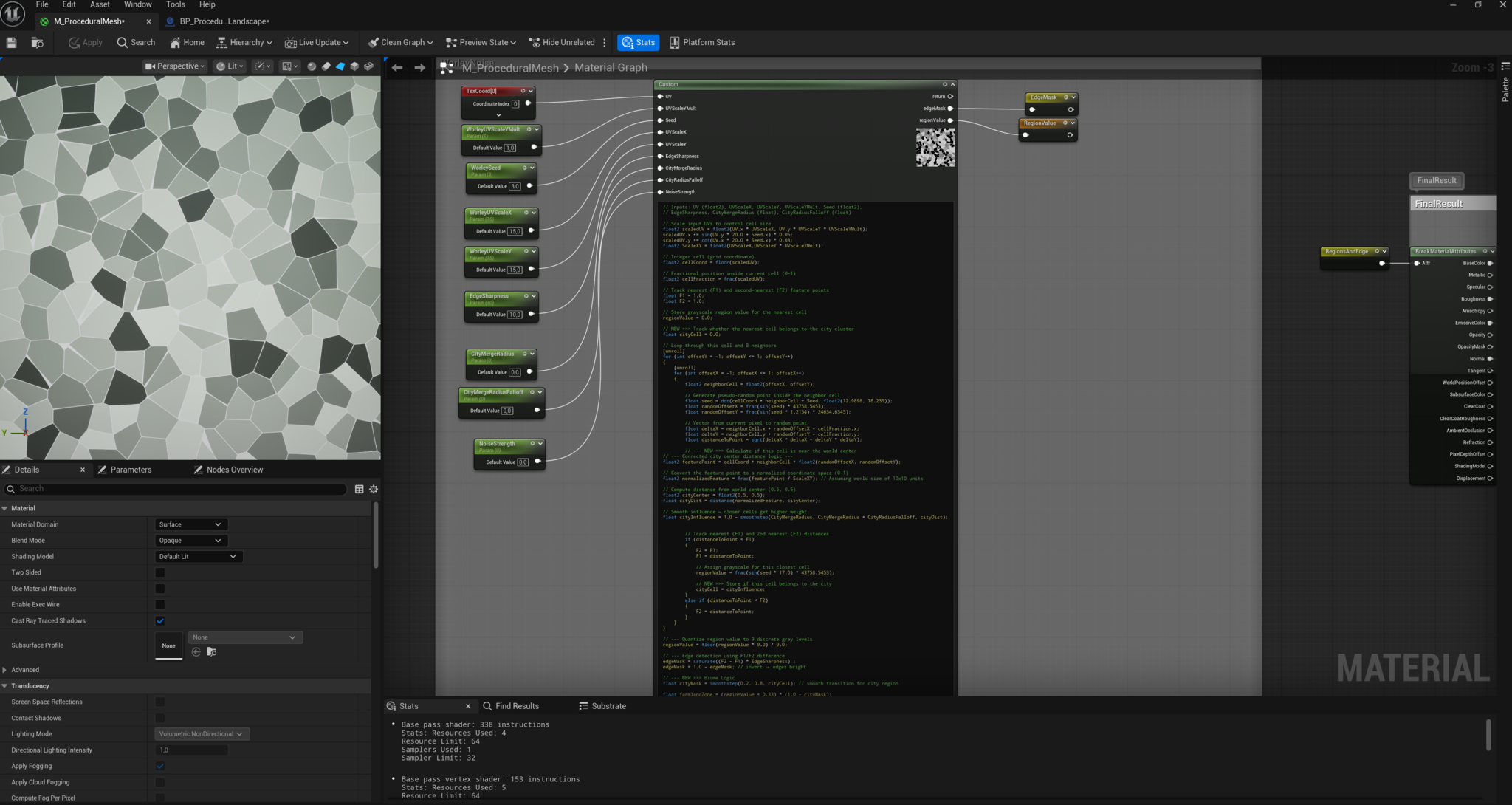
This case study demonstrates a procedural world-generation approach based on Voronoi structures. The available prototype video and images suggest generated region layouts, cell-based terrain or biome boundaries, and world-building experiments for Unreal Engine.
System Breakdown
Procedurally generating a map/world is a pretty cool idea but can easily become a rabbit hole if you want to get great visuals out of it since there are so many variables and factors that need your attention !
I was researching procedurall world generation last year and made a prototype based on voronoi pattern. It was useful as a semi-simple way to divide a world into controllable regions.
Features
many features can be applied to this voronoi approach :
- Texture the regions differently ( grass fields, plowed fields , sand, etc )
- Create masks by merging couple of cells from random or specific location in the UV ( I did create a city mask for example from center of the UV which can be seen in the video )
- Group cells (make a centralized region) into biomes ! which can represent mountain, waterbody, city, desert, etc by specific textures and spawnable objects
- Generate same voronoi pattern in PCG HLSL node and get rid of render target writting/sampling
References
References that inspired the idea:
Result
In the end we went with another approach but this shader was pretty cool !
.png)
.png)
.png)
.png)